

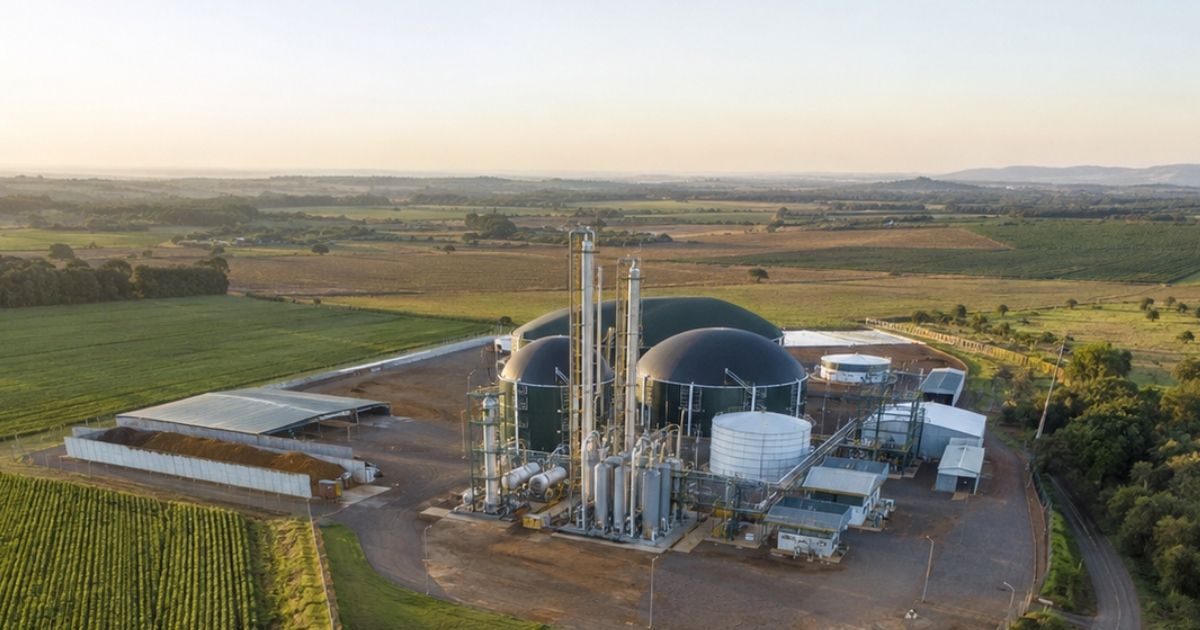
Brazil’s biomethane industry is entering a decisive phase in 2026. The introduction of a mandatory target for the natural gas market, the regulation of Biomethane Certificates of Guarantee of Origin, and the updating of quality standards by the ANP are beginning to consolidate a renewable energy source historically associated with waste recovery as a structured instrument of Brazil’s national energy and climate policy.
From waste recovery to energy policy
For many years, biogas was primarily associated with recovering energy from agricultural, agro-industrial and urban waste, as well as wastewater treatment systems. This origin remains one of its defining characteristics, but the role this energy source can play in Brazil’s energy mix is beginning to take on a broader dimension.
Biogas is produced through the anaerobic decomposition of organic matter and consists mainly of methane and carbon dioxide. When it undergoes purification processes and meets regulatory specifications, it becomes biomethane, a renewable fuel capable of replacing natural gas in a range of applications. Brazil’s National Agency of Petroleum, Natural Gas and Biofuels (ANP) defines biomethane as a gaseous biofuel obtained from the processing of biogas.
This transformation brings together two agendas that were long addressed separately: waste management and energy policy. Materials once viewed exclusively as environmental liabilities are increasingly being considered raw materials with the potential to generate energy and produce renewable fuels.
In a country with a strong agricultural sector, significant agro-industrial production, major urban centers and substantial volumes of organic waste, this connection becomes strategically important. However, technical potential alone is not enough to create a structured market. The expansion of biomethane depends on quality standards, certification mechanisms, clearly defined responsibilities, adequate infrastructure, long-term contracts and sufficiently predictable demand to support new investment.
It is precisely within this set of conditions that 2026 represents an important turning point for the sector.
The regulatory framework begins to take effect
Law No. 14,993, enacted in October 2024 and known as the Fuel of the Future Law, established, among other initiatives, the National Program for the Decarbonization of Natural Gas Producers and Importers and for the Promotion of Biomethane. Subsequently regulated by Decree No. 12,614/2025, the program aims to encourage research, production, commercialization and the use of biomethane and biogas in the energy mix, contributing to the decarbonization of the natural gas market.
The significance of this development lies in the creation of a direct regulatory link between natural gas consumption, emissions and the use of biomethane. In April 2026, Brazil’s National Energy Policy Council established the program’s first target through CNPE Resolution No. 4/2026, setting a greenhouse gas emissions reduction target equivalent to biomethane accounting for 0.5% of natural gas consumption in 2026. The resolution also established the creation of a Biomethane Market Monitoring Committee.
Viewed in isolation, the initial percentage may appear modest, but its economic and regulatory significance is broader. The existence of an obligation linked to the use of a renewable molecule sends a clearer signal across the entire value chain, influencing decisions related to production, certification, commercialization, infrastructure, contracts and investment.
This does not mean that growth is automatically guaranteed. What changes is biomethane’s status within energy policy: rather than relying exclusively on voluntary initiatives, it now formally becomes part of Brazil’s decarbonization framework.
The role of certificates of origin
Another fundamental component of this new framework is the Biomethane Certificates of Guarantee of Origin, known as CGOBs. In February 2026, the ANP approved two resolutions related to the implementation of the Fuel of the Future Law, establishing rules for issuing the certificates and for allocating the annual targets that must be met by natural gas producers and importers subject to the program.
ANP Resolution No. 996/2026 regulates, among other matters, the certification of biomethane producers or importers, the procedures for generating eligible backing for certificates, and the activities of the entities involved in issuing and registering CGOBs. This mechanism is particularly relevant because, under certain trading models, it allows the environmental attribute to be separated from the physical movement of the molecule.
As a result, traceability becomes part of the fuel’s economic value. As energy markets increasingly incorporate environmental targets, emissions-reduction commitments and sustainability criteria, the need to demonstrate the origin, characteristics and attributes of the energy products being used also grows.
It is therefore no longer enough to state that a particular energy source is renewable. Mechanisms are required to demonstrate where it was produced, under what conditions and what volume is effectively associated with the environmental attribute being traded. This regulatory infrastructure is just as important to the maturity of the market as physical production capacity itself.
Quality also moves to the center of regulation
The most recent regulatory development occurred on August 7, 2026, when the ANP Board approved a new resolution aimed at consolidating and improving the rules governing the commercialization, specification and quality control of biomethane marketed in Brazil. The measure results from a review of ANP Resolutions No. 886 and No. 906, both issued in 2022.
Although the issue may appear predominantly technical, its economic relevance is significant. Large-scale energy markets depend on standardization, predictability and clearly defined quality parameters. For a fuel to be contracted by industrial consumers, used in transportation or integrated into gas infrastructure, buyers and operators need to know precisely which requirements the product must meet.
The consolidation of these rules reduces ambiguity and reflects the maturation of the Brazilian market. The biomethane debate is therefore beginning to move beyond the initial question of whether production is viable toward the kinds of questions typical of a sector taking shape: how should biomethane be certified, commercialized, traced, quality-assured, used to meet targets, transported and connected to supply and demand?
The changing nature of these questions is one of the clearest signs that the sector is entering a new stage.
Brazil’s logistics challenge
A large share of Brazil’s biomethane production potential is associated with geographically dispersed activities, including farms, agro-industrial operations, landfills, waste-treatment facilities and other sources of organic matter. Traditional natural gas infrastructure, on the other hand, follows a different geographic distribution, creating a major challenge in connecting production and consumption.
The distance between available feedstock and existing infrastructure or demand directly affects project viability. In some cases, pipeline connections may be technically and economically appropriate; in others, alternative transportation and distribution solutions may play a more significant role.
In June 2026, the Energy Research Office (EPE) published a study specifically addressing the transportation of compressed natural gas, using Brazilian biomethane as a case study, indicating that logistics is already becoming an increasingly important part of planning for the development of this value chain.
The economic viability of a plant does not depend solely on its ability to produce biomethane. Feedstock, processing, specification, logistics and the end consumer must all be connected in an equation capable of supporting the investment. In a country of continental dimensions and with highly dispersed production sources, building these connections will be one of the main challenges to market expansion.
Biomethane and energy security
Energy security has also taken on a more prominent role in this debate. In recent years, supply shocks, geopolitical tensions, fuel-price volatility and the need for greater diversification have brought the issue back to the center of energy strategies in many countries.
Against this backdrop, domestically produced energy sources gain strategic value, especially when they can be derived from resources already available within the country. Biomethane has this advantage because it converts waste generated by other economic activities into a renewable fuel with a wide range of energy applications.
This possibility creates closer links among waste policy, agro-industry, sanitation and fuel production, establishing a direct relationship between environmental management and energy security. In Brazil, expanding this energy source does not depend solely on discovering or developing new reserves, but also on the ability to organize and create value from waste streams that already exist.
This helps explain why biomethane is increasingly being viewed as more than simply a “green fuel.” Its potential is also linked to supply diversification, regional development, the use of local resources and reduced exposure of certain consumers to fossil fuels.
A tool for hard-to-electrify sectors
Electrification will be one of the main drivers of the global energy transition, but it is unlikely to be the sole solution for every economic activity. Industrial processes, transportation systems and certain energy operations may face technical, economic or infrastructure constraints that make direct substitution with electricity more complex.
It is in these segments that lower-carbon fuels can play an important role. Biomethane also has the advantage of being compatible with some of the technologies and infrastructure already developed for gaseous fuels, broadening its range of applications while, naturally, not eliminating the need for new investment.
This does not mean that biomethane is the ideal solution for every application. Its importance lies precisely in expanding the range of alternatives available within an energy system that is expected to become increasingly diversified. Solar power, energy storage, biofuels, energy efficiency, electrification, grid modernization and solutions for hard-to-abate sectors will all play complementary roles.
The strategic question, therefore, is no longer about identifying a single dominant technology, but rather determining which solution can reduce emissions most efficiently in each specific application.
The circular economy moves beyond an abstract concept
Few energy sources embody the logic of the circular economy as directly as biogas. Organic waste that would otherwise require treatment or appropriate disposal can be converted through anaerobic digestion into a usable energy source and, after purification, into biomethane. Depending on the feedstock and technological pathway used, the process may also generate other products and associated environmental benefits.
This dynamic transforms the residual flow of one economic activity into an input for another value chain, connecting waste management, energy and decarbonization. It is precisely this ability to integrate multiple agendas that makes biomethane particularly relevant to sustainability and ESG strategies.
In recent years, much of the corporate discussion around sustainability has focused on emissions inventories, public commitments and target-setting. The next stage is more complex: turning those commitments into tangible changes in production systems, logistics, energy and fuel use, and waste management.
The expansion of biomethane should therefore not be viewed simply as the growth of another energy source. Its development is also linked to the ability to reorganize production flows, reduce emissions, make use of resources that are already available and transform waste into economically valuable inputs.
Regulation does not eliminate market challenges
Despite recent progress, it would be premature to interpret the new regulatory framework as a guarantee of rapid growth in the biomethane market. The consolidation of rules, targets and certification instruments creates more favorable conditions for developing the value chain, but actual expansion will depend on economic, logistical and operational factors that vary considerably across regions and projects.
Feedstock availability and cost, plant scale, proximity to gas infrastructure, transportation alternatives and demand profiles are all factors that directly influence project viability. In many cases, the challenge is not simply producing biomethane, but connecting it competitively to consumers.
Challenges also remain in areas such as financing, long-term contracts, certification, licensing and infrastructure expansion. For new projects to move forward, investors and producers need sufficient predictability to estimate revenues, logistics costs and returns on capital over several years.
The monitoring mechanism established under CNPE Resolution No. 4/2026 is particularly important because it allows policy implementation to evolve alongside changes in supply, demand and prices. Regulatory targets can help create demand and signal investment opportunities, but they do not replace the need for an economically structured value chain.
Likewise, high production potential does not automatically translate into a functioning market without infrastructure, consumers, contracts and conditions capable of providing adequate returns on investment. The sector’s development will therefore depend on its ability to balance regulation, supply growth and demand formation.
Biomethane moves from promise to implementation
The developments seen in 2026 do not mark the end of the process of building Brazil’s biomethane market, but they do signal the beginning of a more concrete implementation phase. The country now has specific legislation, a national incentive program, its first mandatory decarbonization target, regulated certificates of guarantee of origin, and quality and specification standards recently updated by the ANP.
Together, these elements are beginning to form a more structured market architecture. The next challenge will be to turn this framework into projects that can compete economically, secure customers, access infrastructure and deliver measurable emissions reductions.
For a country that combines an electricity mix with a high share of renewable sources and an economy strongly based on agricultural and agro-industrial production, the development of renewable fuels derived from waste represents a distinctive opportunity. Biomethane will not replace fossil fuels on its own, nor will it solve every challenge associated with Brazil’s decarbonization process, but its formal integration into energy policy reflects an important shift in the logic of the energy transition.

Comment