

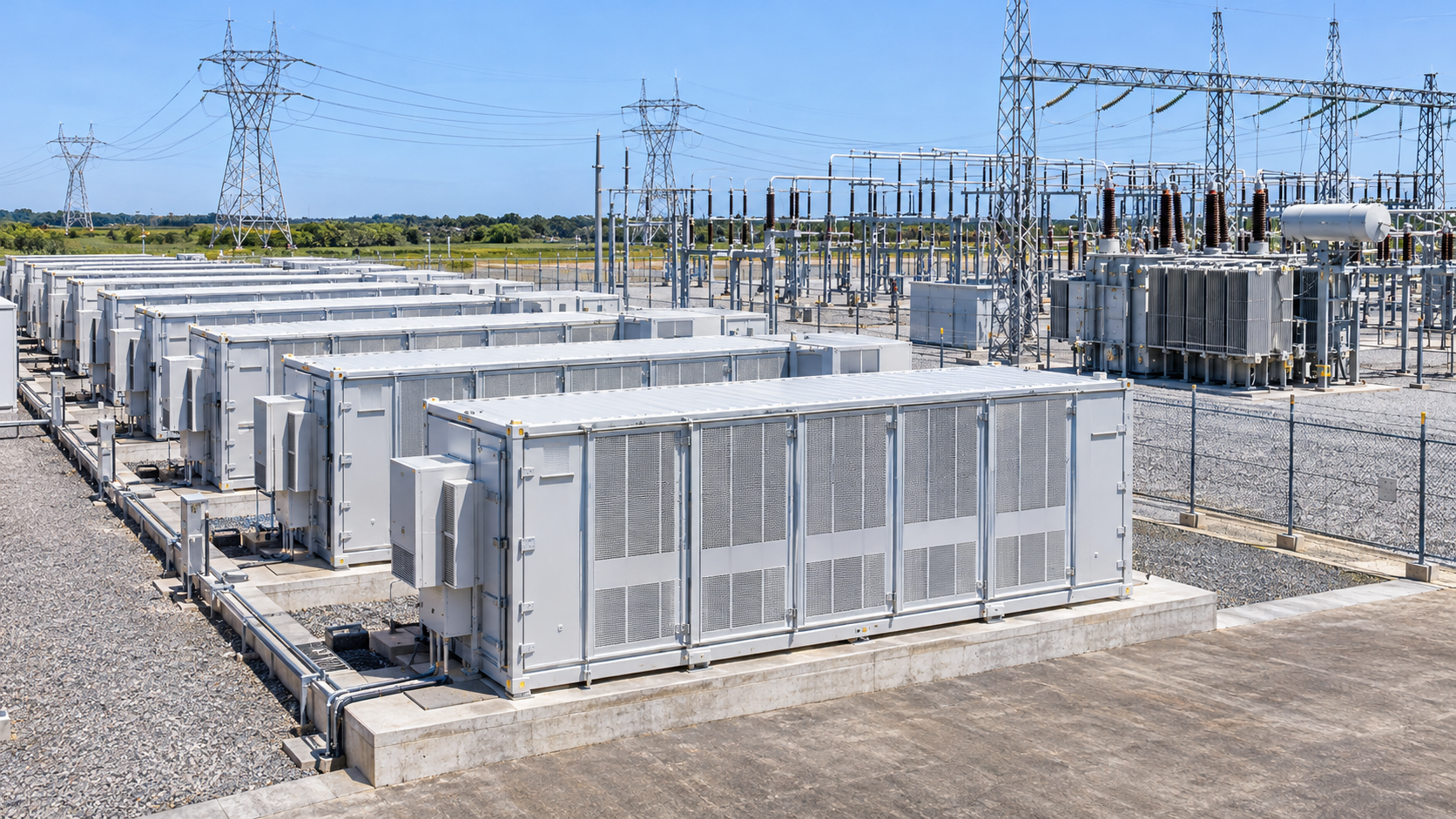
Brazil’s power sector is about to reach a historic milestone. On December 2 and 4, 2026, the country will hold its first auctions dedicated to procuring large-scale battery energy storage systems (BESS). Organized by the Brazilian Electricity Regulatory Agency (ANEEL) and the Electric Energy Trading Chamber (CCEE), the auctions will procure capacity for Brazil’s National Interconnected System (SIN) and launch a market that is already attracting interest from investors, equipment manufacturers, and power generators.
Expectations are high, but the upcoming auctions are surrounded by uncertainty. The main question is who will bear the costs. There is also ongoing debate about the role batteries will play in the power system and how they will coexist with technologies that currently provide firm capacity, such as thermal power plants.
In this article, we explain how the auctions will work, why Brazil has decided to procure battery storage now, the controversy surrounding cost allocation, and, most importantly, whether batteries complement or compete with thermal power plants.
Two Auctions, Two Sets of Rules
The procurement process has been divided into two separate auctions, with guidelines established under MME Normative Ordinance No. 136/2026, published by Brazil’s Ministry of Mines and Energy (MME) in June. According to Movimento Econômico, both auctions will procure capacity availability from standalone battery energy storage systems:
- Auction No. 05/2026, known as “Domestic Storage”, scheduled for December 2, requires batteries to be manufactured in Brazil in accordance with the accreditation criteria established by the Brazilian Development Bank (BNDES);
- Auction No. 06/2026, known as “General Storage”, scheduled for December 4, does not impose this restriction and allows imported equipment.
The auction notices were approved by ANEEL in late October, as reported by Movimento Econômico. The decision to hold two separate auctions serves an industrial policy objective: encouraging domestic equipment manufacturing while continuing to benefit from the competitiveness of imported products.
Different Price Caps for Each Auction
The differences between the auctions also extend to their maximum bid prices. According to an analysis by Modo Energy, the starting price for the open auction, which represents the maximum allowable bid, is BRL 1.58 million per MW per year, compared with BRL 1.76 million per MW per year for the domestic storage auction.
In practice, the government is willing to pay a premium for domestically manufactured batteries to offset Brazil’s higher production costs. For investors, choosing between the two auctions involves factors beyond pricing, including equipment availability, delivery schedules, financing, and, above all, grid access.
The same analysis highlights another important consideration: projects using imported equipment must subsequently compete for available grid connection capacity, commonly referred to as grid export capacity. This makes project location just as important as the bid price.
Why Brazil Has Decided to Procure Battery Storage Now
The primary reason is a technical issue known as curtailment, the forced reduction of power generation. With the rapid expansion of wind and solar power, the electricity system increasingly experiences periods when available generation exceeds demand or transmission capacity. During these periods, Brazil’s National Electric System Operator (ONS) must instruct power plants to reduce or suspend generation.
The problem has grown rapidly. According to S&P Global, curtailment reached 20.8% of wind and solar generation. Agência Cenário Energia reported that financial losses associated with these generation cuts amounted to BRL 6.5 billion in 2025.
Battery storage has emerged as one of the tools for addressing this challenge. Batteries can store electricity during periods of excess generation, such as midday when solar output peaks, and discharge it back into the grid when demand increases and generation declines, typically in the late afternoon. According to the same report, ONS estimates that energy storage could reduce curtailment by up to 50%, depending on the auction results and the successful deployment of the projects.
Batteries Are Not a Standalone Solution
Despite growing enthusiasm, industry experts emphasize an important caveat. In an interview with CNN Brasil, Engeform’s CEO explained that batteries cannot solve curtailment on their own, but they can help mitigate its impacts by providing greater operational flexibility to the power system.
This distinction is fundamental. A reliable power system requires several attributes: energy, capacity, flexibility, inertia, voltage control, and the ability to withstand prolonged periods of supply shortages. No single technology can deliver all of these attributes. Batteries excel in some areas while facing limitations in others.
The Controversy: Who Will Foot the Bill?
The most controversial aspect of the auctions is not technical but financial. Under the current legislation, established by Law No. 15,269/2025, which reformed Brazil’s electricity sector regulatory framework, the costs associated with procuring battery storage would be borne by power generators. If the auctions take place before the legislation is amended, this cost allocation framework will apply, as explained by Movimento Econômico.
To change this arrangement, Bill No. 3,716/2026, for which Federal Deputy Arnaldo Jardim serves as rapporteur, is currently under consideration in Brazil’s Chamber of Deputies. The bill seeks to revise the battery storage cost allocation framework before the auctions take place. According to Times Brasil, on November 4, seven industry associations, including Abeeólica, Absolar, Abrage, Abragel, Absae, Abihv, and Apine, requested support from six government ministries to secure the bill’s approval before the auctions.
The concern is well-founded. The contracts will have a term of 15 years, and entering into these long-term commitments without clarity over who will bear the costs increases risk for all stakeholders. For power generators, bearing the costs exclusively represents a significant new financial burden. For battery storage investors, uncertainty surrounding the remuneration framework could affect their willingness to participate in the auctions.
This situation illustrates a recurring challenge in Brazil’s power sector: the need for regulatory predictability to support long-term investment. This issue has been explored on the EPP blog, in an article examining how today’s decisions will shape the energy that industry will need over the next decade.
A Remuneration Model Inspired by Transmission Assets
Another noteworthy aspect of the auction design is its remuneration model. According to the Engeform executive interviewed by CNN Brasil, the proposed structure brings energy storage projects closer to the remuneration model used for electricity transmission assets.
This means that batteries will be remunerated primarily based on capacity availability, rather than the actual amount of electricity delivered. This follows the same principle as the capacity reserve auctions that contracted thermal power plants in 2021 and 2026: the power system pays to have resources available when they are needed.
This feature provides investors with greater revenue predictability and facilitates project financing. At the same time, it requires energy storage systems to meet stringent availability and performance requirements throughout the contract term.
Batteries and Thermal Power Plants: Competitors or Complementary Technologies?
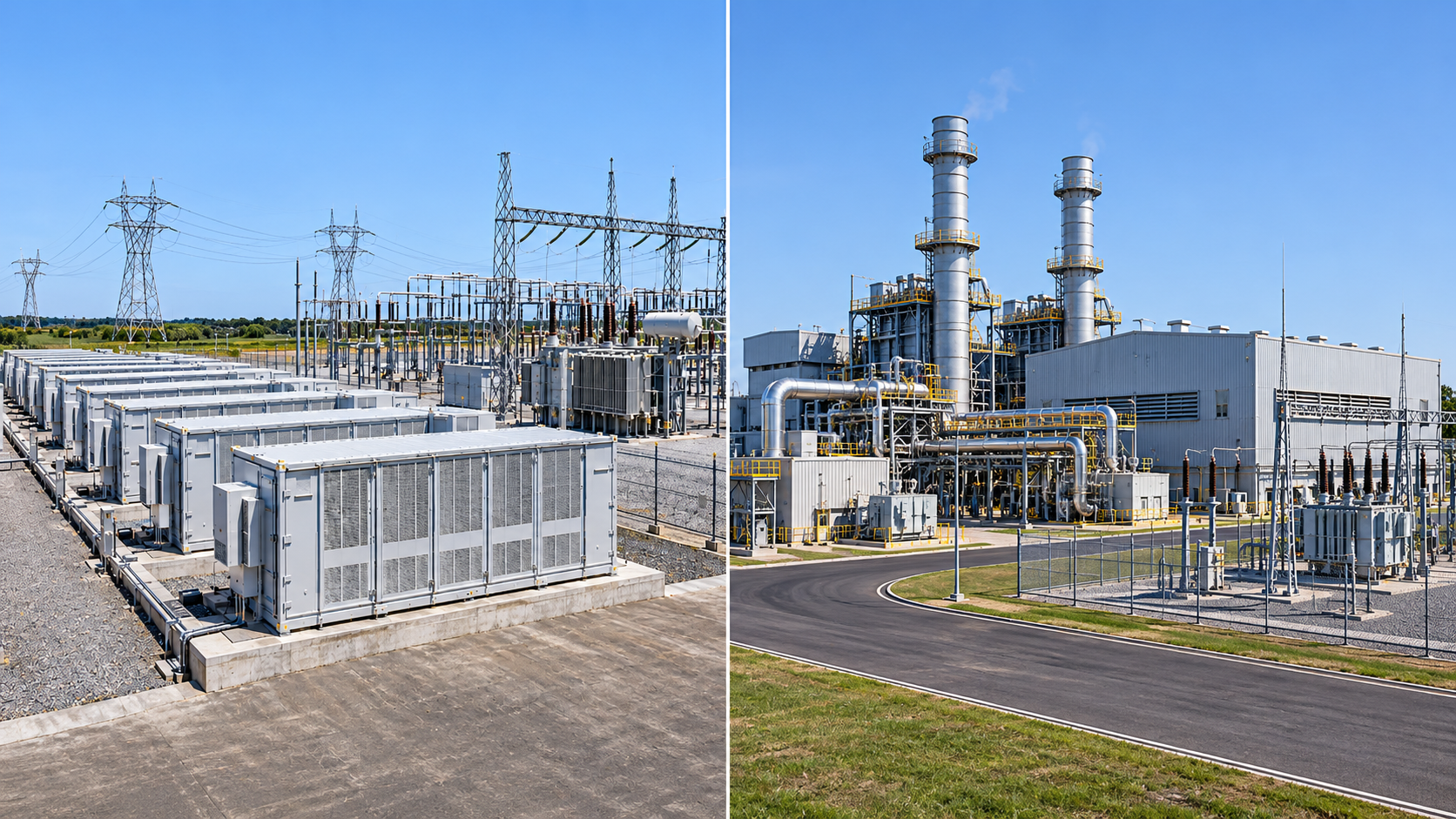
This is arguably the most relevant question for firm capacity project developers. The short answer is that the two technologies are more likely to complement than compete with each other. To understand why, it is important to examine what each technology delivers.
What Batteries Do Well
- Extremely fast response times: Batteries can inject electricity into the grid or absorb it within fractions of a second;
- Energy time-shifting: They store excess renewable generation and discharge it several hours later;
- Ancillary services: They support frequency regulation and grid stability;
- Modular deployment: Battery storage systems can be deployed within relatively short timeframes and at different scales.
Where Batteries Face Limitations
- Limited discharge duration: Large-scale battery storage systems are generally designed to discharge over several hours, rather than days or weeks;
- Dependence on recharging: Batteries can only deliver electricity if they have been charged beforehand, which depends on the availability of surplus energy;
- Degradation: Storage capacity declines over successive charge and discharge cycles.
What Thermal Power Plants Do Well
- Firm capacity over extended periods: Thermal power plants can operate continuously for days, weeks, or months, provided that fuel remains available;
- Security of supply during hydrological crises: They have ensured electricity supply during periods of low reservoir levels, such as Brazil’s 2021 water crisis;
- Independence from weather conditions: They do not rely on sunlight, wind, or rainfall;
- Contribution to grid stability, through inertia and voltage control.
In practice, a power system with an increasing share of variable renewable generation requires both types of resources: fast-response technologies to manage fluctuations throughout the day and sustained generation resources to withstand prolonged periods of low renewable output or drought.
What the 2026 Capacity Reserve Auction Has Already Demonstrated
Recent developments reinforce this perspective. In March 2026, Brazil’s Capacity Reserve Auction (LRCAP) contracted approximately 19 GW of capacity, predominantly from natural gas-fired thermal power plants, as reported by CNN Brasil. A second round contracted an additional 501 MW from oil-, diesel-, and biodiesel-fired power plants, according to Agência Brasil.
The battery storage auctions now complement this development by introducing a different type of capacity resource. Power system planning is moving toward a diversified capacity portfolio, in which thermal power plants, reservoir-based hydropower plants, batteries, and other flexibility technologies operate in a coordinated manner.
Incentives Under Discussion at ANEEL
Beyond the auctions themselves, ANEEL has been evaluating additional mechanisms to encourage energy storage deployment. According to Canal Solar, the alternatives under consideration include extending generation authorization terms, granting preferential treatment in the curtailment order to power plants equipped with batteries, offering grid usage discounts, and establishing minimum requirements for new projects.
These discussions indicate that energy storage is expected to gain traction not only as a standalone resource procured through auctions but also as a technology integrated into existing power plants. For the industry, this opens up a range of emerging business models.
The Timeline Leading Up to the Auctions
To understand the current landscape, it is worth reviewing the developments that have brought Brazil to this point:
- November 2025: The MME publishes its first ordinance establishing guidelines for a capacity reserve auction dedicated to battery storage, initially scheduled for April 2026;
- June 2026: Normative Ordinance No. 136/2026 revises the guidelines and divides procurement into two separate auctions, one with domestic content requirements and another open to imported equipment;
- August 2026: ANEEL holds a public hearing on the proposed auctions;
- October 2026: ANEEL approves the auction notices for Auctions No. 05 and No. 06/2026, while the Energy Research Office (EPE) and ONS review the minimum grid connection requirements for energy storage systems;
- November 2026: Industry associations advocate for the approval of Bill No. 3,716/2026 before the auctions;
- December 2 and 4, 2026: The auctions are scheduled to take place.
The postponement from the originally scheduled date illustrates the complexity of launching an entirely new market, which requires grid connection rules, performance criteria, cost allocation frameworks, and equipment accreditation mechanisms.
What to Watch for in the Auction Results
Once the auctions take place, several indicators will help reveal the market’s response:
- Contracted capacity in each auction, indicating the actual level of investor appetite;
- Discounts relative to the price caps, reflecting the level of competition;
- Price differences between the domestic and general storage auctions, revealing the cost of the local content policy;
- Location of winning projects, indicating where energy storage is expected to ease grid constraints;
- Profile of successful bidders: Established power generators, new market entrants, equipment manufacturers, or investment funds;
- The outcome of Bill No. 3,716/2026, which could change how costs are allocated.
What This Means for Capacity Project Development
For companies developing power generation and firm capacity projects, the introduction of battery storage into the power system does not eliminate opportunities, but it does reshape the market landscape. Several developments deserve particular attention:
- The value of flexibility is increasing: The power system is increasingly rewarding resources capable of responding quickly and delivering capacity during critical periods;
- The duration of capacity delivery is becoming more important: Resources capable of operating over extended periods are likely to gain value in a system with a significant share of short-duration resources;
- Location matters more than ever: Available grid connection capacity is becoming a strategic asset;
- Capacity auctions are becoming firmly established as Brazil’s primary mechanism for procuring power capacity.
EPP (Evolution Power Partners) is closely monitoring these developments, given its focus on developing power generation projects that contribute to the reliability and security of the electricity system. The introduction of battery storage reinforces a trend that has been taking shape for several years: a power system that remunerates not only electricity itself but also the attributes that ensure it is available when needed.
Conclusion: A New Chapter, Not a Replacement
The battery storage auctions scheduled for December 2 and 4 represent a milestone for Brazil’s power sector. They will establish a large-scale energy storage market, encourage domestic equipment manufacturing, and provide an important tool for reducing renewable energy curtailment.
However, expectations must be carefully managed. Batteries are a valuable resource for addressing short-term fluctuations, not a replacement for technologies capable of delivering firm capacity over extended periods. The power system of the future will most likely be built around a combination of technologies, each delivering the attributes it provides most effectively.
Before that can happen, however, the industry must resolve the question still hanging over the auctions: who will foot the bill? The answer will shape not only the outcome of the December auctions but also investor confidence in the next stages of energy storage expansion in Brazil.
Explore more insights and analysis on the power sector on the EPP blog.
