

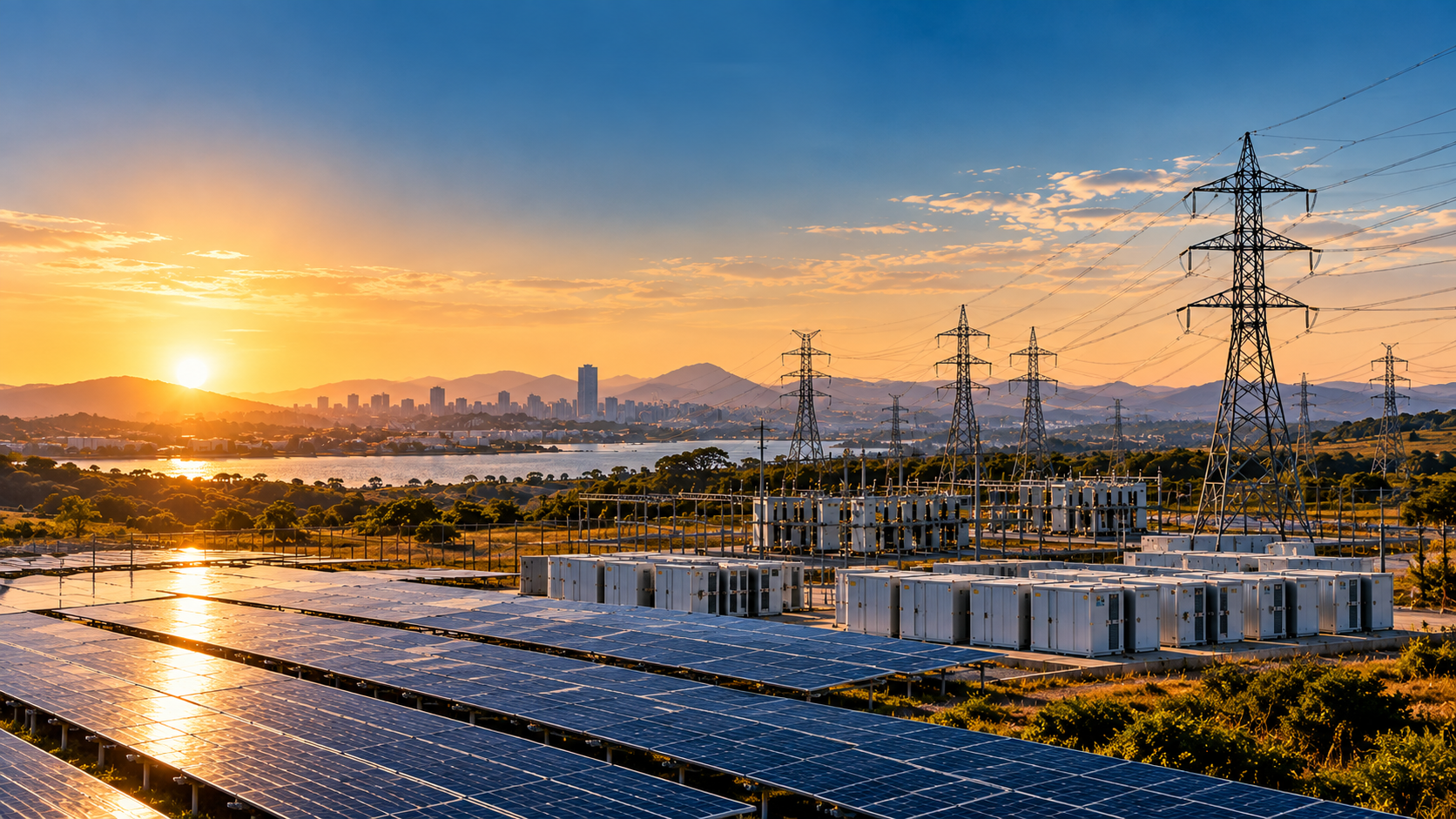
A Record Year for Renewables That Is Still Not Enough
The expansion of renewable energy worldwide has never been faster. In 2025, approximately 693 GW of new renewable capacity came online, bringing global installed capacity to around 5.15 TW. It marked another record in a trajectory that continues to gain momentum and steadily reshape the composition of the global power system.
Even so, the current pace will not be enough to meet one of the main international targets established for this decade.
The latest edition of the report Delivering on the UAE Consensus: Tracking progress toward tripling renewable energy capacity and doubling energy efficiency by 2030, produced by the International Renewable Energy Agency, IRENA, together with the COP31 Presidency and the Global Renewables Alliance, estimates that the world will need to reach 11.2 TW of installed renewable capacity by 2030. To achieve this, annual additions will have to rise to approximately 1,204 GW per year between 2026 and 2030. In other words, the world will need to install close to 1.2 TW of new renewable capacity every year.
The report was presented during Climate Week NYC and represents the third assessment of progress toward the commitments established under the COP28 UAE Consensus. The agreement called on countries to contribute to tripling global renewable power capacity and doubling the rate of improvement in energy efficiency by the end of this decade.
The scale of the challenge becomes clearer when the 2025 result is compared with what will be required from now on. Even after a record-breaking year, annual additions will need to increase by roughly three-quarters to reach the required trajectory. The growth rate of renewable capacity, which stood at 15.5% in 2025, will need to average close to 16.7% per year over the remaining period through 2030.
The figures could lead to a simple conclusion: the world needs to build more solar parks, wind farms, hydropower plants and other renewable energy facilities. The report itself, however, reaches a more complex conclusion. The challenge is no longer only about how much generating capacity can be built. Increasingly, it is about the ability to connect, transmit, store, distribute and use that energy.
This is precisely where the energy transition is beginning to enter a new phase.
)
Solar Continues to Lead Global Expansion
No technology illustrates the pace of this transformation better than solar photovoltaic power.
Of the 693 GW of renewable capacity added globally in 2025, approximately 512.7 GW came from solar power. In other words, nearly three-quarters of all new renewable capacity installed worldwide that year was solar. Global photovoltaic capacity reached approximately 2.39 TW.
Wind power added another 158.4 GW in 2025, bringing cumulative capacity to around 1.29 TW. Hydropower, bioenergy, geothermal and other technologies accounted for the remainder of the expansion.
The scale reached by solar power demonstrates how far some technological and economic barriers have already been overcome.
IRENA had previously highlighted how declining costs transformed the competitiveness of renewables. In its latest assessment, the agency states that around 90% of newly commissioned renewable capacity has lower costs than the cheapest new fossil-fuel alternatives in their respective markets.
Just over a decade ago, much of the energy debate focused on whether solar and wind could compete economically with conventional technologies. Today, in many markets, the discussion has shifted.
The question is no longer simply how much it costs to generate renewable electricity. It increasingly includes how much it costs to integrate that electricity into the power system, where it should be connected, how it should be transmitted and how operational reliability can be preserved as its share increases.
This shift is fundamental to understanding the next stage of the energy transition.
The Bottleneck Is Beginning to Shift from Generation to Infrastructure
Building a power plant does not, by itself, make electricity available to consumers.
Between the energy resource and the point of consumption lies an extensive infrastructure consisting of substations, transmission lines, distribution networks, control systems, compensation equipment, storage, grid connections and an operational structure that must continuously balance supply and demand.
The faster generation capacity grows, the more quickly this infrastructure must expand alongside it.
This is precisely where the new report identifies one of the greatest risks to the 2030 targets.
IRENA states that grids are not being expanded and modernized at the same pace as renewable generation. As a result, connection queues are growing, projects are facing delays and power systems are beginning to deal with increasing volumes of available generation that cannot always be transmitted to where demand exists.
The problem can already be quantified. According to data compiled in the report, approximately 2,500 GW of renewable generation projects, energy storage and new large loads at advanced stages of development are awaiting grid connections across different markets worldwide. That represents capacity equivalent to nearly half of all renewable power capacity currently installed globally.
Not all of these projects will necessarily enter operation, and grid connection queues vary considerably from one country to another. Even so, the scale of the backlog illustrates how the physical and regulatory capacity to connect new projects is becoming a central variable.
A power system may have abundant solar resources, available land, competitively priced equipment, interested investors and demand for electricity. But if the grid cannot receive and transmit that generation, part of this potential will remain outside the system.
This represents an important change in the logic of power-sector expansion. During the first stage of the energy transition, public policies concentrated much of their efforts on enabling renewable technologies and reducing their costs. In the stage now beginning to take shape, the infrastructure required to make use of those technologies is becoming just as important as generation capacity itself.
Nearly $1 Trillion a Year for Power Grids
The scale of the investment required shows that this is far from a marginal issue.
Under IRENA’s updated 1.5°C scenario, annual investment in power grids needs to reach approximately $902 billion by 2030. In 2025, global investment in transmission and distribution stood at around $450 billion. The required volume will therefore need to almost double.
This capital will have to finance different types of infrastructure.
Part of it will go toward building new transmission lines capable of connecting regions with strong generation potential to major consumption centers. Another share will be required to reinforce existing grids, modernize substations, expand interconnection capacity, digitalize systems and adapt distribution networks to increasing volumes of distributed generation, storage, electric vehicles and new loads.
There is also a timing challenge. Solar plants and certain wind projects can be deployed within relatively short timeframes. Major transmission corridors, by contrast, typically require longer processes involving planning, permitting, procurement, equipment acquisition and construction.
If generation and transmission begin to be planned only at the same time, there is a risk that generation projects will be completed before the infrastructure required to deliver their electricity is ready.
This is why grid planning needs to become increasingly anticipatory. Expansion must take into account not only generation that has already been contracted, but also the locations where new centers of supply and demand are likely to emerge.
This is especially important in a system where the location of energy resources does not always coincide with the location of the largest consumption centers.
More Installed Capacity Does Not Necessarily Mean More Energy Can Be Used
Another concept is becoming central to this discussion: curtailment.
At certain times, a renewable power plant may have the conditions required to produce electricity, but the power system may be unable to absorb all of that production. Generation must therefore be reduced.
The reasons can vary. Transmission capacity may be constrained, supply may temporarily exceed demand, equipment may be unavailable, operational security requirements may apply, or the system may lack sufficient storage and flexibility.
IRENA’s report itself makes an important distinction. Curtailment does not always indicate an infrastructure deficiency. In power systems with high shares of renewable energy, some degree of economically driven curtailment may represent an efficient decision during certain periods of excess supply.
The problem arises when curtailment begins to reflect structural limitations that systematically reduce the ability to make use of available energy.
In that case, adding more generation capacity may produce diminishing returns if infrastructure does not evolve at the same pace. The result is a gradual change in how the success of the energy transition is measured. For years, installed gigawatts have served as one of the main indicators of progress. They will remain important, but they will no longer be sufficient.
It will also be necessary to assess how much potential generation can actually reach the grid, how much electricity can be transferred between regions, how much can be stored and how much flexibility exists to respond to changes in production and consumption.
The power system is no longer measured solely by the amount of infrastructure installed, but increasingly by its ability to integrate those assets.
Energy Storage Is No Longer Merely a Complementary Technology
The growth of battery storage helps illustrate how power systems are beginning to respond to this need.
In 2025, approximately 112 GW, equivalent to around 307 GWh of battery storage capacity, was added globally. Installed power capacity increased by 48% compared with the previous year. China, the United States and Europe accounted for nearly 85% of new installations.
Investment in energy storage, including pumped-storage hydropower, reached approximately $103 billion in 2025, an increase of 33% year over year.
At the same time, costs continue to decline. According to data compiled by IRENA, the cost of a fully installed battery storage project fell by nearly 30% between 2024 and 2025 alone. Compared with 2010, the cumulative decline is approximately 95%, bringing costs to around $140 per kWh in 2025. This has important implications because it changes the economic role of storage.
Batteries are not simply devices capable of storing electricity for later use. They can absorb surplus generation, deliver power when demand rises, alleviate congestion, support frequency control and increase the operational capability of systems with high shares of variable renewable energy.
The market is also beginning to reflect this integration.
Around one-quarter of utility-scale solar capacity commissioned worldwide in 2025 was deployed in projects paired with energy storage, according to data cited in the IRENA report.
This points to a transformation in the very concept of a renewable energy project.
In some markets, value is no longer derived solely from generating as much electricity as possible when the sun is shining or the wind is blowing. It increasingly depends on the ability to deliver electricity during periods when the system needs it most or when it has greater value.
The distinction may appear subtle, but it is structural. The energy transition is beginning to move from a discussion based predominantly on energy produced toward one that also encompasses power, availability, timing, location and flexibility.
Flexibility Goes Beyond Energy Storage
Batteries are among the most visible solutions, but flexibility should not be treated as synonymous with storage.
A flexible power system has multiple resources capable of adjusting supply and demand as conditions change.
Regional interconnections allow electricity to be transferred from areas with surplus generation to areas with higher consumption. Hydropower plants with reservoir regulation capability can play an important role in certain systems. Dispatchable renewable generation, including certain biomass and biogas applications, can complement variable sources. Consumers can also shift the timing of their electricity use through demand-response mechanisms.
Digitalization adds another dimension. Smarter systems can combine weather forecasts, load information, grid conditions and real-time data to make more precise operational decisions. IRENA also highlights artificial intelligence and digitalization among the tools that can improve coordination between renewable supply and electricity demand, which is expected to grow.
The result is a power system very different from the one built throughout the twentieth century.
Instead of a small number of large power plants serving relatively passive demand, the electricity sector is increasingly combining large-scale projects, distributed generation, energy storage, flexible loads, electric vehicles, consumers who also generate electricity and increasingly dynamic power flows.
Complexity increases, but so does the range of options available to system operators.
The infrastructure underpinning the energy transition, therefore, will not consist solely of steel, cables and batteries. It will also depend on software, information, automation, market
