

The legal deadline for closing open dumps has already passed. PLANARES requires that nearly 50% of waste be recovered by 2040. Yet 40.3% of everything Brazilians discard still goes to inadequate destinations — around 87,000 tons per day. Waste to Energy (WtE) has stopped being a technology of the future and has become an urgent necessity of the present. Understand how it works, what the law requires, where Brazil stands, and what companies like Eva Energia are already doing to turn this environmental liability into an energy asset.
What is Waste to Energy (WtE) and how does it work?
Waste to Energy (WtE) refers to a set of technologies that convert municipal solid waste that cannot be recycled into electricity, heat, or fuels. In the waste management hierarchy, WtE deals with residual waste: what remains after sorting and recycling and would otherwise go straight to landfills or open dumps without proper treatment.
There are four main technological routes. Incineration with energy recovery is the most established globally: waste is burned at temperatures above 850 degrees Celsius, the heat produces steam, the steam drives turbines, and electricity is generated. Gasification converts waste into syngas, a combustible gas, through heat in a low-oxygen environment. Pyrolysis thermally decomposes waste in the complete absence of oxygen, producing combustible gases and oils. Anaerobic digestion breaks down the organic fraction using microorganisms without oxygen, generating biogas that can be converted into electricity or purified into biomethane.
Energy efficiency is significant and technically proven. According to ABREN and Biosphere World, a WtE plant generates on average 600 kWh of electricity per ton of waste. A sanitary landfill with biogas capture extracts only 65 kWh per ton. In other words, an energy recovery plant is about ten times more efficient for the same amount of material. In addition, the Ministry of Mines and Energy confirms that incineration plants generate between 450 and 700 kWh per ton of municipal solid waste.
Environmental benefits reinforce the argument: WtE plants eliminate up to 98% of the physical volume of waste, reduce methane emissions from landfills — a gas 25 times more harmful than CO2 — and replace fossil-fuel thermoelectric generation. The 5th IPCC Report concluded that WtE plants are the most effective way to mitigate emissions caused by methane from municipal solid waste. They are also a firm, non-intermittent energy source, serving as a strategic complement to solar and wind power.
The legal framework: from PNRS to PLANARES
To understand the urgency of WtE in Brazil, it is necessary to know the legislative framework governing waste. The starting point is the National Solid Waste Policy (PNRS), established by Law No. 12,305/2010. After nearly three decades of debate in Congress, the law established principles, targets, and shared responsibilities among government, companies, and society. When it was enacted, it already required the closure of open dumps by 2014. The deadline was not met.
In 2020, the New Legal Framework for Sanitation (Law 14,026/2020) extended deadlines in stages: capitals and metropolitan regions were supposed to close dumps by 2022; municipalities with 50,000 to 100,000 inhabitants by 2023; and municipalities with fewer than 50,000 inhabitants by August 2024. Reality once again fell short of the law.
The most strategic instrument arrived in 2022: the National Solid Waste Plan (PLANARES), published by Decree No. 11,043 on April 13, 2022. It is not merely legislation. It is a 20-year plan with concrete targets, diagnostics, and indicators. It is this plan that turns WtE into a legal obligation rather than just a best practice.
PLANARES Global Indicator 3 required the elimination of improper final disposal by 2024. Target 4 establishes that the recovered mass of waste must reach 13.8% in 2024, 20% in 2026, and 48.1% by 2040. The concept of recovered mass explicitly includes thermal treatment with energy recovery. Without WtE, the 2040 target is mathematically impossible to reach using traditional mechanical recycling alone.
The post-2024 bottleneck: the deadline passed, the dumps remained
The most recent figures for the sector come from the Solid Waste Panorama in Brazil 2025, published by ABREMA in December 2025 with 2024 data. The diagnosis is straightforward: Brazil generated 81.6 million tons of municipal solid waste in 2024, a 0.75% increase compared with the previous year. Of this total, 76.4 million tons (93.7%) were collected. But only 41.4 million tons (59.7% of what was collected) received environmentally adequate disposal. In other words, 40.3% of all waste generated still goes to improper locations such as dumps and controlled landfills.
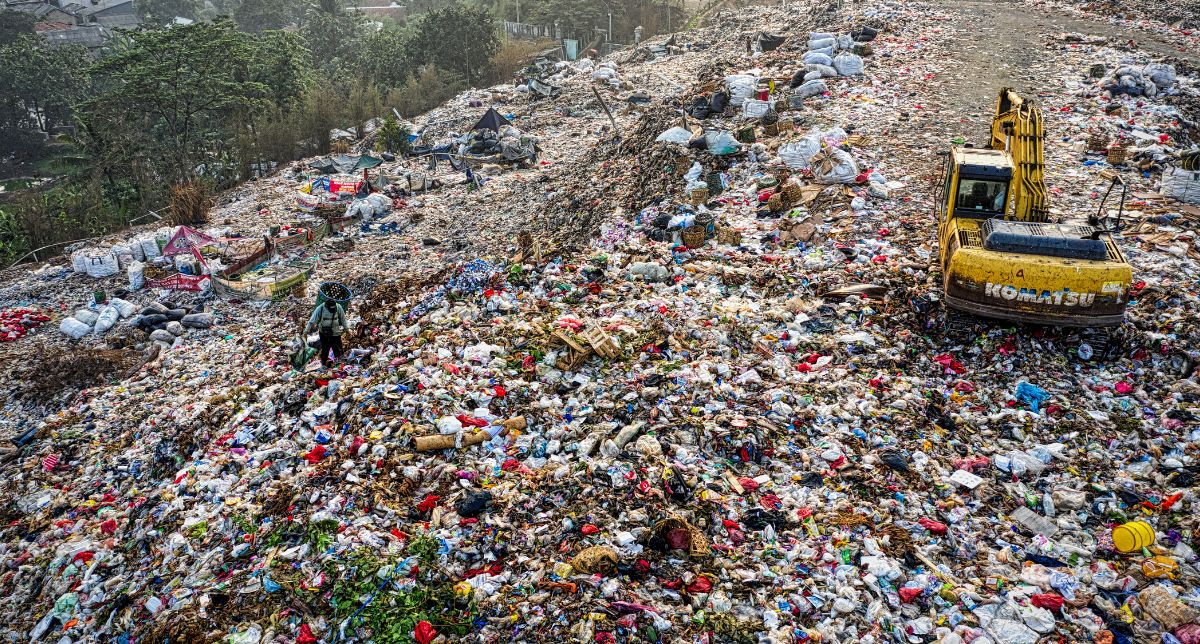
In absolute terms, more than 33 million tons per year are dumped in irregular sites — the equivalent of about 87,000 tons per day without proper destination, according to data from WTEEC Engineering & Consulting. This waste contaminates groundwater, releases methane into the atmosphere, and exposes populations to public health risks.
ABREMA records more than 2,500 open dumps still operating in the country. Municipal governments and intermunicipal consortia face increasing pressure from environmental agencies and public prosecutors, who accelerated legal actions after the 2024 deadlines expired.
If we add the 87,000 tons that leave dumps every day to the waste that must be diverted from landfills to meet PLANARES targets, we reach a potential demand of nearly 100,000 tons of municipal solid waste per day requiring treatment and recovery solutions. That is the scale of the market WtE could occupy in Brazil.
Brazil’s potential and projects underway
Brazil is, paradoxically, one of the countries with the greatest untapped potential for energy generation from waste. According to the Brazilian Association for Energy Recovery from Waste (ABREN), considering only the 28 metropolitan regions with more than one million inhabitants, Brazil has the potential for 2.3 GW of installed WtE capacity through 114 plants, with annual generation of 18.8 million MWh, supplying up to 3% of national electricity demand. If 47% of the country’s total municipal solid waste is considered, this potential rises to 3.3 GW, enough to supply more than 4 million households.
The economic potential is proportional: according to ABREN, the sector could generate more than 200,000 direct and indirect jobs and mobilize R$ 200 billion in investments and taxes over 40 years. Considering the complete ecosystem of energy recovery — WtE, biogas, and biomethane together — the investment potential in the coming years exceeds R$ 500 billion, according to updated data from ABREN.
PLANARES 2024 quantified objective targets: 994 MW of WtE through thermal recovery, plus 252 MW from landfill biogas and 69 MW through anaerobic digestion, all by 2040, totaling R$ 54.67 billion in investments just for federal targets.
Even so, Brazil does not yet have any large mass-burn WtE plant in operation. The main project under construction is URE Barueri (SP), with 20 MW and capacity to process 825 tons of residual waste per day, expected to begin operations in 2027. Other projects in advanced licensing stages include URE Mauá (80 MW, 4,000 tons/day, Grupo Lara) and Ciclus Ambiental (30 MW, Rio de Janeiro), in addition to the Consimares consortium in Campinas. The first three projects alone represent more than R$ 2.5 billion in Capex investments, according to ABREN.
In the biogas sector, the potential is even greater. ABiogás estimates that Brazil could produce 120 million m³ of biogas per day, enough to replace up to 70% of national diesel consumption. Current production is around only 500,000 m³ per day, less than 0.5% of total potential. The Future Fuel Law (Law 14,993/2024) created a mandatory purchasing mandate for biomethane and the Biomethane Guarantee of Origin Certificates (CGOBs), integrating the sector into national energy policy.
Eva Energia: when organic waste becomes clean energy
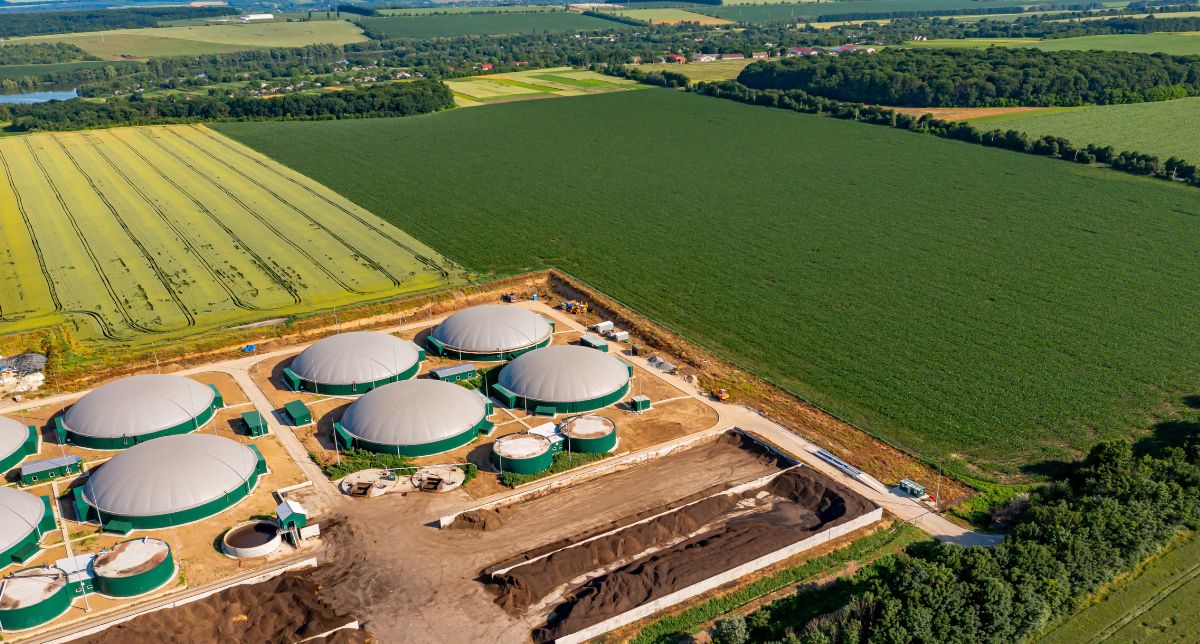
While the debate around WtE faces regulatory bottlenecks in the field of urban residual waste, companies like Eva Energia demonstrate that energy recovery from organic waste is already a reality in Brazil. Through innovative biogas and biomethane projects, the company connects agribusiness and rural waste management with solutions that reduce emissions, generate local value, and help diversify the energy matrix.
One of its most emblematic cases, presented at the 6th Southern Brazilian Biogas and Biomethane Forum, is the Eva plant at Fazenda Mano Julio: 47 biodigesters that use pig manure to generate electricity. The model closes the circular economy loop: animal waste becomes biogas, biogas becomes electricity, and the by-product of biodigestion — digestate — returns to the soil as organic biofertilizer, replacing chemical inputs and generating a new source of income for producers.
The business logic is straightforward: an environmental liability becomes raw material. For agribusiness, this means reduced methane emissions — a gas 25 times more harmful than CO2 — compliance with growing ESG requirements, eligibility for the RenovaBio program (which monetizes decarbonization through CBios), and additional revenue from what used to be waste disposal. With the biomethane mandate coming into force in 2026, projects like those of Eva Energia gain even greater revenue predictability.
Eva Energia represents what the Brazilian energy and waste sectors most need in 2026: proven economic viability, scalable growth, and measurable environmental impact. Every cubic meter of biogas captured represents an equivalent amount of CO2 that does not enter the atmosphere and can be monetized. That is the circular economy operating beyond PowerPoint slides.
The three bottlenecks holding back WtE in Brazil in 2026
Despite the enormous potential and legal urgency, WtE is advancing slowly. Analysis by ABREN and WTEEC identifies three structural obstacles that reinforce one another:
Lack of a specific regulated tariff: Unlike solar, wind, and hydroelectric power, WtE does not have a guaranteed remuneration mechanism. ABREN is working to ensure the technology can participate in dedicated auctions with prices between R$ 550 and R$ 650 per MWh, a ceiling that ensures economic viability. Until that happens, institutional investors remain distant from capital-intensive projects.
Unfair competition with sanitary landfills: The average landfill disposal fee ranges from R$ 100 to R$ 120 per ton, according to ABREN. For WtE plants to be financially viable without explicit government subsidies, the electricity produced needs to be remunerated between R$ 550 and R$ 650 per MWh. As long as burying waste remains cheaper than treating it, municipal managers cannot close the financial equation.
Lack of adequate credit lines: WtE does not have dedicated credit lines at BNDES nor tax incentives like those granted to the solar sector. With Brazil’s benchmark interest rate above 13% per year in 2026, the cost of capital for long-payback projects becomes prohibitive without robust revenue guarantees. The creation of CGOBs for biomethane and the potential extension of similar mechanisms to WtE are pointed out as priority solutions.
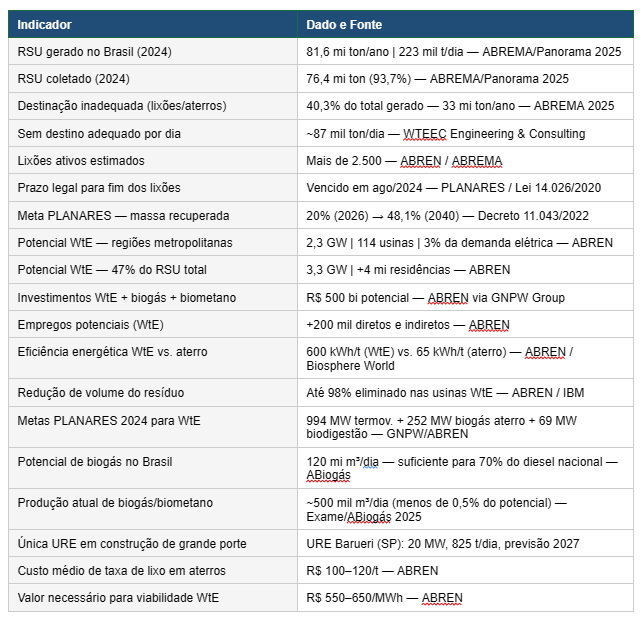
Data Panel: Waste and Energy in Brazil
Waste is worth billions. Brazil still prefers to bury it
Brazil has one of the most advanced environmental legislations in the world regarding solid waste. It has published federal targets, established deadlines, and available technologies. What is missing is convergence between regulation, financial incentives, and political will so that WtE moves from exception to state policy.
The arithmetic of 2026 is simple: it is impossible to meet PLANARES targets without energy recovery. It is impossible to eliminate the more than 2,500 active dumps without treatment alternatives for residual waste. And it is impossible to honor Brazil’s climate commitments while tens of thousands of tons of methane escape daily into the atmosphere from landfills without proper capture.
What Eva Energia and other pioneers in the sector have already demonstrated is that turning waste into energy is not utopian. It is mature technology, a viable business, and above all a legal obligation that Brazil can no longer postpone. Every ton of residual waste converted into electricity means one fewer dump, one more carbon credit, and a concrete step in the energy transition the country so often proclaims.
The window of opportunity is open. The first capacity auction that allowed WtE participation was attempted in 2021, and no project was contracted due to lack of price competitiveness. With PLANARES as the legal foundation, biomethane regulated by the Future Fuel Law, and URE Barueri as proof of technical feasibility, the conditions for the next cycle are stronger. Municipalities that organize themselves into consortia, investors with a long-term vision, and companies capable of execution face the greatest opportunity in Brazilian sanitation in recent history.

Comment